Motivating Literacy: Digital Badges in the School Library

Badge Display

Most of my 2nd to 5th grade students tend to read within the same literary genre. Fantasy is by far the most popular, from the Magic Tree House to the Deltora Quest and Percy Jackson series. To motivate my students to explore other genres as well, I’ve decided to begin Badging the Library. It’s baby steps at first, but I am hoping to expand eventually.

You all have seen digital badges–maybe in the form of a community badge displayed in the sidebar of your favorite blog? Or possibly you’ve downloaded AASL’s Rising to the Challenge conference attendance badge? Then there are achievement badges, which are popular in the video game industry. I’ve created skills badges. The purpose of skills badges is to allow students to demonstrate that they have met a learning objective. A great example is Khan Academy, where badges are awarded to display mastery in seven unique skills. My genre reading badges are not at all as elaborate as Khan’s, but I do hope they are just as motivating.

Badging_the_Library__A_PreFlection_-_Google_DriveFor now, I’ve created seven different genre badges for students in grades 2 through 5 (28 badges total). Creating the badges was much easier than anticipated. I looked at various badge designer options and eventually settled on openbadges.me by MyKnowledgeMap (they do have a WordPress plugin as well). To create a badge, you simply select from various choices for each the shape, inner shape, icon, banner, and text. Super easy!

OpenBadges.me_»_Badge_designer_and_Microsoft_Word

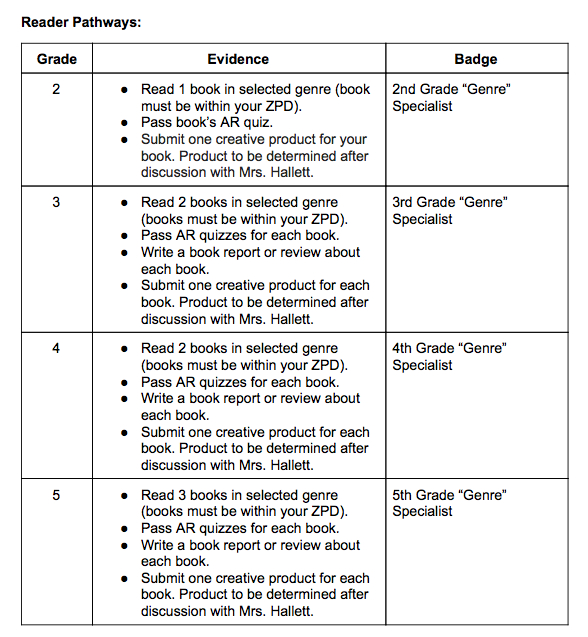
To earn a genre reading badge, students have to complete a learning path (see below). The creative product can be anything from a recorded book talk to a trailer to trading cards to a comic strip to mindmaps to animations… Badges will be collected in “My Badge Backpack”, a page on each of my student’s blogfolios.

Reading Pathways

My goal for the badge implementation is to serve as a reading incentive program. Moreover, I want to entice students to explore new genres. In this sense, the learning is entirely student-driven, thereby empowering them to play a stronger role in their own learning.  Students are not required to participate, although I do hope that many will.

So while I am starting small, I see great potential for expansion. For example, one of my curricular areas is digital citizenship. Rather than making badge earning voluntary, it could be a form of assessment–letting students demonstrate what they know–and documenting it for instructional purposes.

Born Digital

Recently, I had the pleasure of working closely with our Kindergarten teacher and her students. The students are currently learning all about bar graphs. As part of their learning, their teacher helped them create a two-question online survey: 1) What is your favorite ice cream flavor? and 2) Where do you live? The kids created a survey in Google Forms. My job was to introduce the students to Twitter and help them formulate a Tweet asking fellow Tweeters around the globe to participate in the survey.

Tweet

I have been thinking about the students’ response to my question: What are some ways we communicate? Their answers included Facetime, texting, and Skype (in that order). Not only was I was struck by their answers, but even more so by what they did not say: The students did not mention email as a means of communication and when asked how they would get a picture they had drawn to their grandparents, they did not mention snail mail.  But, on the other hand, when I pointed to that little blue bird, a couple of students could tell me that it represented Twitter.

My 14-year old son and his friends recently told me that they don’t really use Facebook–because it is for “older people” (i.e., us). Instead, you can find them on Instagram, Snapchat, and Vine (neither are my social media turf).

Like you, I am a digital immigrant not a native, and I’m trying to keep up. Our kids are growing up with forms of communication that were unimaginable when we were children. And the pace of technology change is increasing.  When our Kindergarten students know Twitter but not regular mail, times have changed. But of course, they know nothing different (for now). Emphasizing the rudiments of all communication regardless of format, however, remains the key to early learning and literacy: community, respect, and the ability to listen. It is so enjoyable to hear from our youngest students all the new ways they communicate with the world.

My Mission as an Educator

This school year, we are implementing Stephen Covey’s 7 Habits as part of a school-wide Community of Kindness initiative. Our younger students will be creating classroom mission statements and our older students will be writing personal mission statements. As an exercise, all faculty were asked to write their professional mission statements. Here is mine:

My Mission as an Educator

My core mission is to provide a nurturing, safe, and stimulating environment for exploration of the information universe. I strive to instill in my students habits of lifelong reading, thinking, and learning, while developing ambition, curiosity and personal excellence. I aim to assist teachers and students in developing the competencies necessary for accessing and evaluating information from diverse sources.  Above all, I seek to empower all learners to the best of my ability.

Modern Classroom Learning: Creating and Publishing Collaborative eBooks

Photo Skitch Document

Photo Skitch Document-1

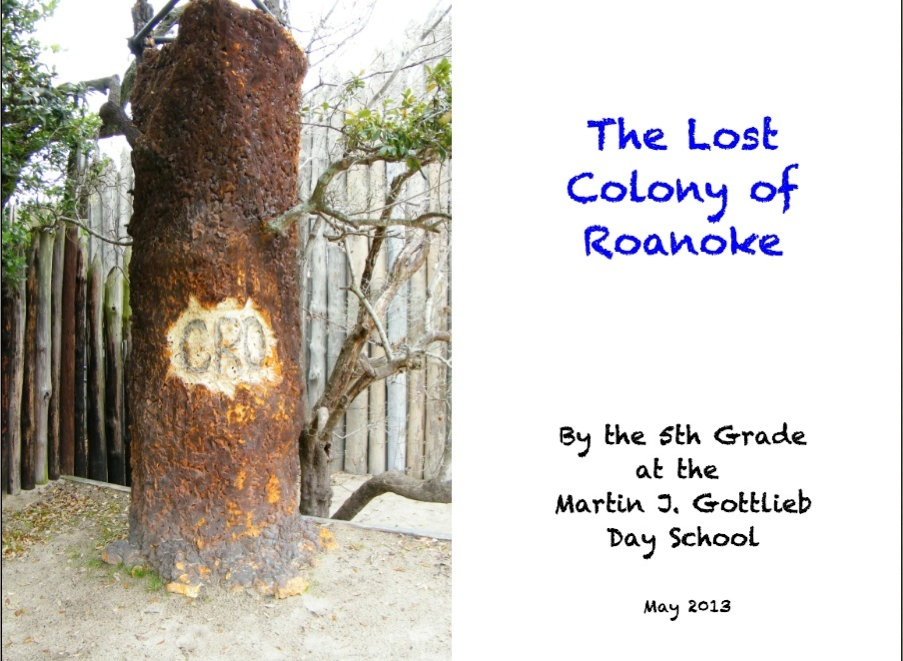
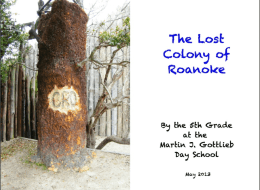
My 4th and 5th grade students finished creating ebooks on Fort Caroline, the first French settlement attempt in the New World, and the Lost Colony of Roanoke, respectively. This was a collaborative project with their social studies teacher, Ms. Shelly Zavon. Information sources were web-based, previously gathered, organized, and annotated using Diigo. Each student (5th grade) or student pair (4th grade) contributed a chapter to their class books.

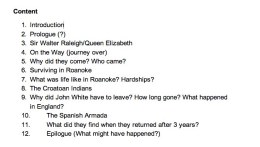
1. Brainstorming. Drawing on their subject knowledge, students began by brainstorming possible chapter topics and then putting them in an order.
Untitled document - Google Drive

2. The Writing Process. Once topics were distributed, students began the pre-writing stage by selecting relevant websites, reading the information, and taking notes to organize their ideas. Students used Google Docs and each shared their documents with the classroom teacher and me. This allowed us to provide immediate feedback. In addition, some students also chose to share their work with friends in the class, seeking their input as well. It was particularly important to provide feedback to students at this pre-writing stage as some found it difficult to narrow information to their particular topic or to simply stay focused on their section of the book to avoid overlapping with another section. And we needed to make sure that facts were accurate. Since the writing process required several stages, including extracting relevant information from the sources, drafting, revising, and editing text, it took multiple sessions.

The Colonists - Google Drive

It was very important to me that students take ownership of this project. So, periodically, we checked our progress as a group. We read through all draft sections and checked facts, suggested word choice changes, provided syntax and grammar corrections, and incorporated transitions between the sections. Reading as a group had the added benefit of providing each student with a better idea on their classmates’ content.

Also, once drafts were complete, I provided each student/student pair with a checklist to ensure writing mechanics were in order. Checklists are a great form of self-assessment for the students that ensure learning and also provide them with a sense of project ownership.

eBook Checklist3. Images. Each section was to include at least one relevant image. This allowed me to teach a mini-lesson Creative Commons images and where and how to find them. For our history topics, we found Wikimedia Commons a great resource.

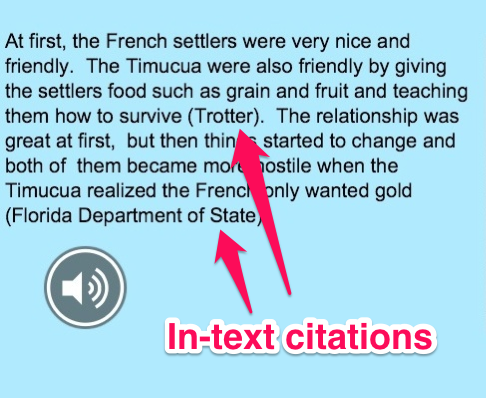
4. Information Ethics. Creating and publishing an ebook is a great tool to teach students digital citizenship. For this project, I introduced an adapted version of the MLA citation style. Students learned to create proper citations for both text and images. Their sections include in-text citations.

Photo Skitch Document

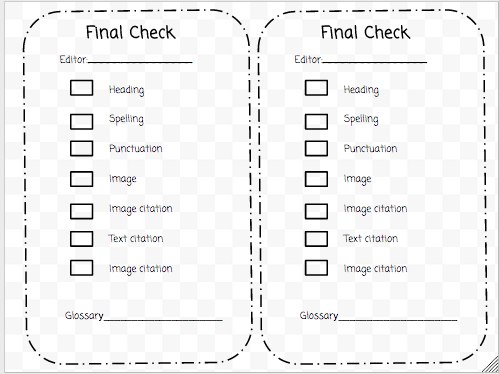
5. Product. Students used BookCreator app for iPad to create their books. Before importing text and images, students checked each other’s work one last time. For this purpose, I provided them with a Final Check sheet. Fifth grade students also compiled a glossary and editors were asked to identify words/phrases to include in the glossary during the final check.

eBook Final Check - Google Drive

The last step was to decide on a format for the ebooks. Each class brainstormed several options for font style, color and size as well as background color.Each also co-designed the book covers and wrote group reflections. Once their sections were finalized, they sent them to me via email as ibooks. I combined the books into one and added the Table of Contents, Works Cited,  Image Credits, and, in the case of 5th grade’s book, the Glossary pages. The final products are multi-modal, including text, audio, images, and hyperlinks.

6. Assessment. The classroom teacher and I informally assessed both the process and the quality of work through observation and reading of all documents at each drafting stage. If we felt we had to take a step back to bring the group together, we did take the time. For example, after reading all drafts, we realized that there was some repetition of information between different book sections. To ensure the students own this project, we then read all drafts as a class to identify repetitive information. We also continually provided feedback on all written work. Most students received comments/suggestions from both of us.

IMG_0614

photo 3

Reflection

For both my colleague, Shelly, and I this project was meant to not only deepen our students’ understanding of the time periods and historical events they researched by engaging them in the publication of a book, but from the beginning we wanted this to be a student-centered/student-owned project. Creating and publishing ebooks is a very involved process, but it is worth the time spent planning and then guiding the students.

This project promoted the development of multiple literacies. Students learned so many skills, from writing (organization, word choice, sentence fluency, transitions, and mechanics) to editing/proofreading to finding Creative Commons images to citing sources to collaborating to  fluently transition between multiple apps (Google Drive, browser, BookCreator) to publishing. This project incorporated all the hallmarks of modern learning: Creativity, Critical Thinking, Collaboration, and Communication.

Should you decide to hop on the ebook publishing train with your students, remember to be flexible and to allow time. Each stage of the project evolved slowly in accord with their own unique tasks–research, writing, publishing. Slow but deliberate work is key. In retrospect, the project was more about the process than the end product, not only for the teachers but the students as well (read the “Project Reflection” pages in their ebooks).

My students are sharing their work with a global audience and are looking forward to receiving authentic feedback — from you! Please leave them a comment.

Click to download books from the iBooks store:

The Lost Colony of Roanoke:

Fort Caroline: The First French Settlement in the New World

Or view them below:

eBooks: Step-by-Step

Research

Young readers typically focus on fiction books. Since a couple of my first graders were showing interest in nonfiction books, however, I thought it would be a good idea to introduce the whole class to this genre and take the opportunity to also teach them about nonfiction text features and some basic research steps along the way.

To jump start, I randomly distributed a number of nonfiction books (emergent and fluent reader texts, 0.8 to 4.5 AR book levels) on each of our four group tables and asked students to look through the books, noting any differences to fiction books. I then showed them on the projector screen Big Cats (by DK Publishers) from the wegivebooks.org website. We looked through selected pages and identified various text features, including the table of contents, headings, captions, diagram, and labels, discussing the purpose of each.

Since one of my goals was to introduce very basic research skills to this class, we discussed what research is and established that good research starts with a “Wonder” question. We brainstormed a list of questions students may wonder about an animal.

Each student chose a book about an animal on their reading level. They then thought of a question they were wondering about their animal and wrote it in the organizer I had created.

My Animal Report

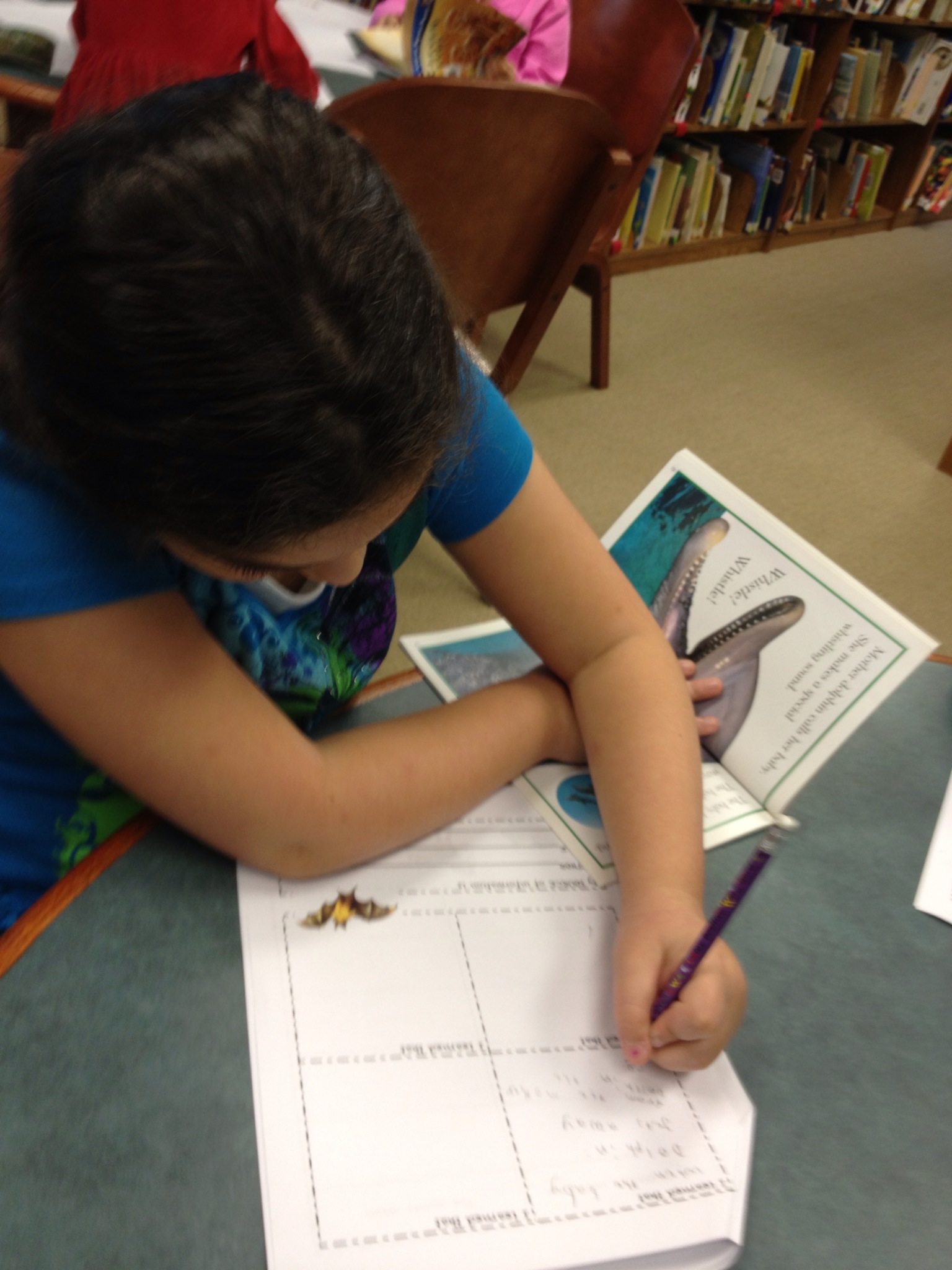
We spent the next two sessions gathering information from the texts to complete the multi-page organizers. Students drew the animal and labeled it. They drew a picture of its habitat and another of its diet. Then they noted at least four facts about their animal. By far the hardest part was for students to compile a five-word glossary. I decided to model this process by reading a section in a book (projected on the screen) and identifying words that provide information about the animal. This process forced students to read their texts closely to not only identify words (or phrases) but also to figure out their meaning.

photo 2

photo 3-1

I deliberately approached this project step-by-step rather than let each student work at their own speed. So for each section of the organizer, we discussed the type of information to complete and I either modeled or showed examples. Then it was the students’ turn before we moved on to the next part of the organizer. Those students who completed their sections first worked with classmates who benefited from some help or simply encouragement.

photo 1 11-37-41

photo 1

It’s never too early to introduce students to the concept of ethical use of information. So one section of the organizer required the “Source of Information”. We discussed plagiarism and the importance of citing information sources. For our purposes, students noted author names and book titles on their organizers.

Source Info

My 1st graders have experience using various iPad apps, including BookCreator, which they’ve used to create fiction books in the Fall. For this project, I wanted students to again use BookCreator to show their learning. Since it is impossible to create drawings in BookCreator, I decided to introduce the class to ExplainEverything, an app my daughter’s been using for her school work. Its a versatile tool for creating and can also be used for screencasting.

In all, each student created four images: An image for their cover page, a diagram of their animal complete with labels and a picture each of the animal’s habitat and diet. Once finished, the drawings were saved as image files to the iPad’s Camera Roll.

photo 4

photo 3

photo 4

The next step was to import the images into BookCreator app for iPad and transfer the text from the graphic organizer to BookCreator.  We spent several sessions on this. Each time, I emphasized the need to make sure all required elements are included and sentences have proper punctuation and capitalization. Invented spelling was just fine.

photo 1

photo 2-3

Our last session was a “quality check”: going through the book to check for all required elements (cover page, table of contents, wonder question and answer, diet, habitat, diagram with labels, facts, glossary, source, headings) as well as punctuation and capitalization.

photo 2-1 (1)

I was a bit worried that this project would drag on too long for the students to remain engaged, but they displayed an incredible work ethic throughout. They loved to learn about the animals and at all times lots of verbal sharing of information was going on. Also, I do believe that the use of iPads helped to keep them motivated. While I required that students included certain text features and information elements), it also was important for me to allow students to  exhibit their creative sides. So even though I mentioned that dark text on light background is easier on the eyes, some students just “really liked” the very light turquoise colored letters on white background, or the rather swirly fonts. Not easy on my much older eyes, but the products are definitely the students’!  I believe if we want students to take ownership of their learning and products, they must be allowed such simple freedoms.

The outcome of the digital nonfiction books is incredible! I am so impressed with my 1st graders’ skills. I feel very lucky to be working with such a creative group of kids. Each of them worked hard on their projects (a total of 13 45-minute sessions) to produce quality books about their research. Their books speak for themselves!

Inspired By Seth Godin

Seth Godin just published his 5000th post (!). This is obviously an incredible accomplishment, but what caught my attention was a link to another post nominated by one of his friends as outstanding amidst Godin’s many publications. It was published in 2004 and is short, so I am quoting it in full:

Five years from now…

Assume that:

Hard drive space is free

Wifi like connections are everywhere

Connections speeds are 10 to 100 times faster

Everyone has a digital camera

Everyone carries a device that is sort of like a laptop, but cheap and tiny

The number of new products introduced every day is five times greater than now

Wal-Mart’s sales are three times as big

Any manufactured product that’s more than five years old in design sells at commodity pricing

The retirement age will be five years higher than it is now

Your current profession will either be gone or totally different

What then?

IceHand_Ornamental_Divider_Englische_Linie

Isn’t that amazing?! Literally everything Godin predicted is trending in the direction he pointed out in 2004!  But Godin’s last point, “Your current profession will either be gone or totally different,” prompted me to reflect about my own professional life. I’ve been a librarian for 16 years now, academic for the most part, but for the last 1 ½ years in a K-8 school. And I’ve grown in each role.

The field of education has been greatly impacted by the digital revolution. Recognizing this shifted paradigm, teachers and librarians have been at the forefront of using the new tools to advance their professions and student learning. While the digital revolution has always had its pessimists who predicted a future without books and libraries, the role of librarianship has certainly evolved. New products and new practices constantly influence and change the nature of our work–almost always improving it.  In 2004, when Godin posted the above, I was employed at a community college. At the time, the college administrators and their hired architects designed a new “Information Commons” (aka library space) with only very little real estate for book shelving. Why? Well, because books would soon gain antiquity status. As my much wiser students would say, “Never!”

To rephrase Seth Godin’s closing question: What if I had not embraced change? My profession would not have been gone, but I would no longer be a participant. I would have become extinct, irrelevant. But I would also have missed a lot. Professionally, my job continues to change and I’ve learned to embrace this. Is there anxiety and trepidation at times? For sure! But our brains are not wired to be dormant. I watch our students who are not afraid to try new things, who are curious and creative and willing to try. As a good friend of mine has said many times over: Learning is messy! But it can be so rewarding and fun.

Interactive, Visual Student Reports

According to Wikipedia, visual literacy is

the ability to interpret, negotiate, and make meaning from information presented in the form of an image, extending the meaning of literacy, which commonly signifies interpretation of a written or printed text. Visual literacy is based on the idea that pictures can be “read” and that meaning can be communicated through a process of reading.

In today’s digital information economy, visual media and visual literacy are more important than ever. Developing the skills necessary to successfully negotiate the digital information universe, however, can be a challenging task. While anyone can create and share visual media, from basic image sharing via Facebook or FlickR to curation sites that rely on images such as Pinterest, Learnist, or ScoopIt, it is as important to be a discerning viewer and user of visual media as it is to be an expert producer.

Producing visual media expertly  is a skill my 4th grade students recently tackled when working on a biography project. Students have been studying Florida history with their social studies teacher, Shelly Zavon, and are working on expository writing with their language arts teacher, Stephanie Teitelbaum. Their teachers assigned them to research and write an essay about a well-known Floridian or person with strong ties to Florida. Since the students already had several sessions with me learning about website evaluation when “Googling”, I decided to introduce them to another search tool, Sweetsearch, which only searches a defined, safe list of websites. It was very easy for each student to find source material to write their essays.

Rather than concluding the project with the essay, we decided to have students create a visual representation of their work. I had been playing around with ThingLink and decided it was the perfect tool. ThingLink allows users to create media-rich images. Links to different media content are embedded in an image and can be viewed/read/listened to without leaving the image. The idea is, according to ThingLink, to “tell your stories.”

Once students completed the essay-writing-process, their first task was to find a Creative Commons image to use as a visual representation for their project. Most students found an image of the person. But others used an image of a statue of the person, an image of the Ringling circus cart, and an image of an old fort. Understanding the ethical issues surrounding the creation and use of images has been an ongoing learning process for my students and this project lend itself perfectly to reinforce those skills.

In ThingLink, the selected image functions as a starting point for the various types of media added. On the image, each item is represented by an icon, or “nubbin” in ThingLink lingo, of choice. To ensure consistency across their interactive, visual report, we agreed on the type of nubbin for each type of media content.

NubbinsReferenceSheetThingLink

In their ThingLinks, students were required to include their essays as links (a Google Doc published to the Web), the websites used as information sources for the essays (one “Person” nubbin each), and the proper citation for the images used (the “i” nubbin). All supplemental media content could incorporate any information in the bullets below, of which the students found a great variety.

  • Images
  • Biographical websites
  • Videos
  • Podcasts
  • Interviews (text and audio)
  • Museum exhibits
  • Statues
  • Quotes
  • Book reviews

Finding and evaluating other media content required students to think more deeply about the person they were researching in order to create meaningful representations.

To complete the process of creating a ThingLink, students used a checklist for self assessment.

Despite the fact that my 4th graders have been learning about using information ethically all year, there were still two of the 20 students who used images that were copyright protected. Consequently, both had to redo their projects–which took each only about 10 minutes at the most. Creating the ThingLink itself is easily accomplished, but selecting content to place in context and evaluating it is rather time-consuming. For student learning, this project was clearly about the process not the product. To create their interactive, visual reports, students learned and continued to build upon various skills, from the research and writing processes to digital citizenship to technology to visual literacy.

(BTW, there is also a free mobile ThingLink app, which as of May 2013 is still quite clunky, but I cannot wait to work with it once fully developed.)

Just like my students, I think you are going to find this visual format appealing. Here are some examples of the stories they are telling (click the images to open):

Real Author, Engaged Learning

imgres

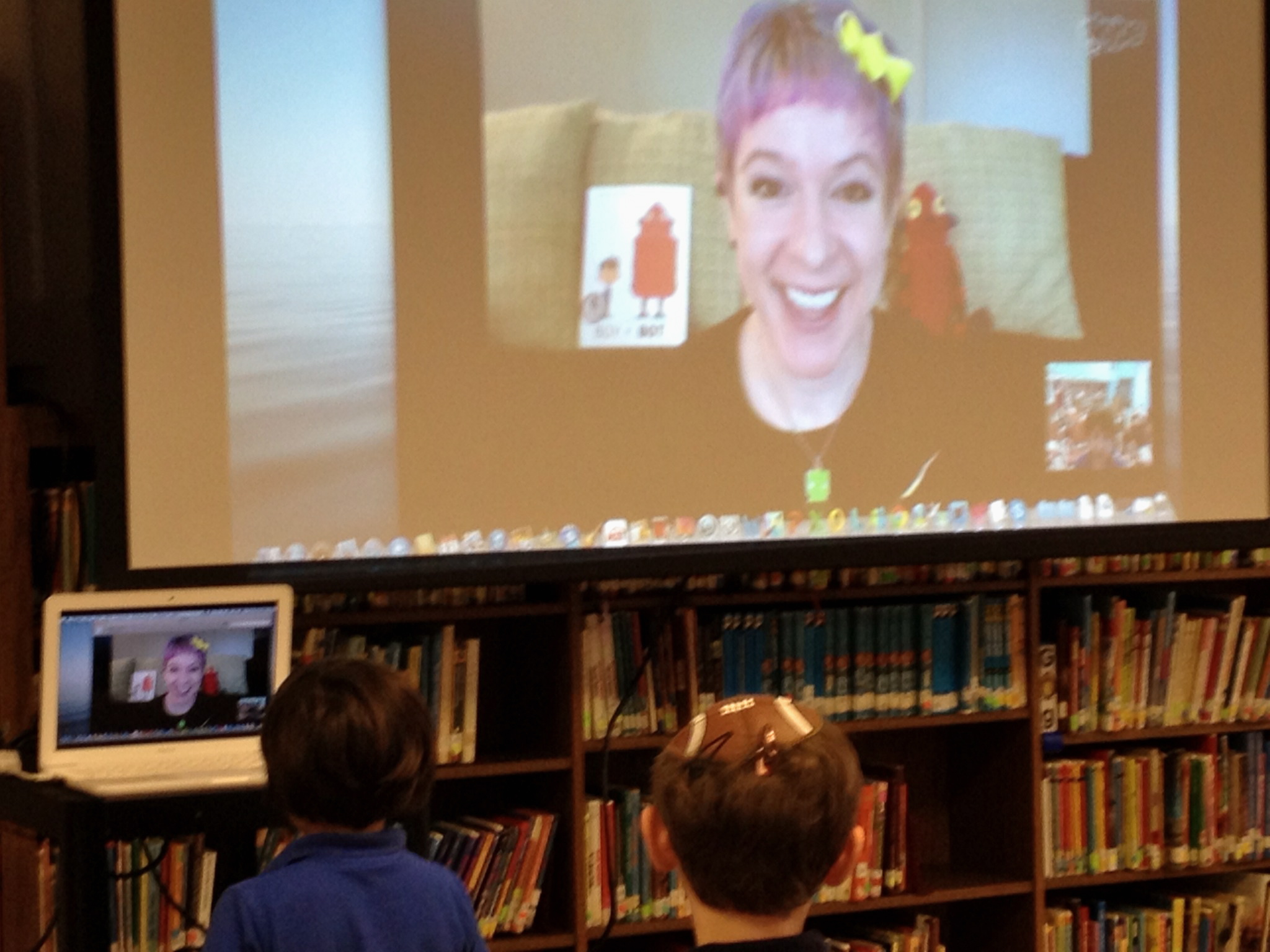
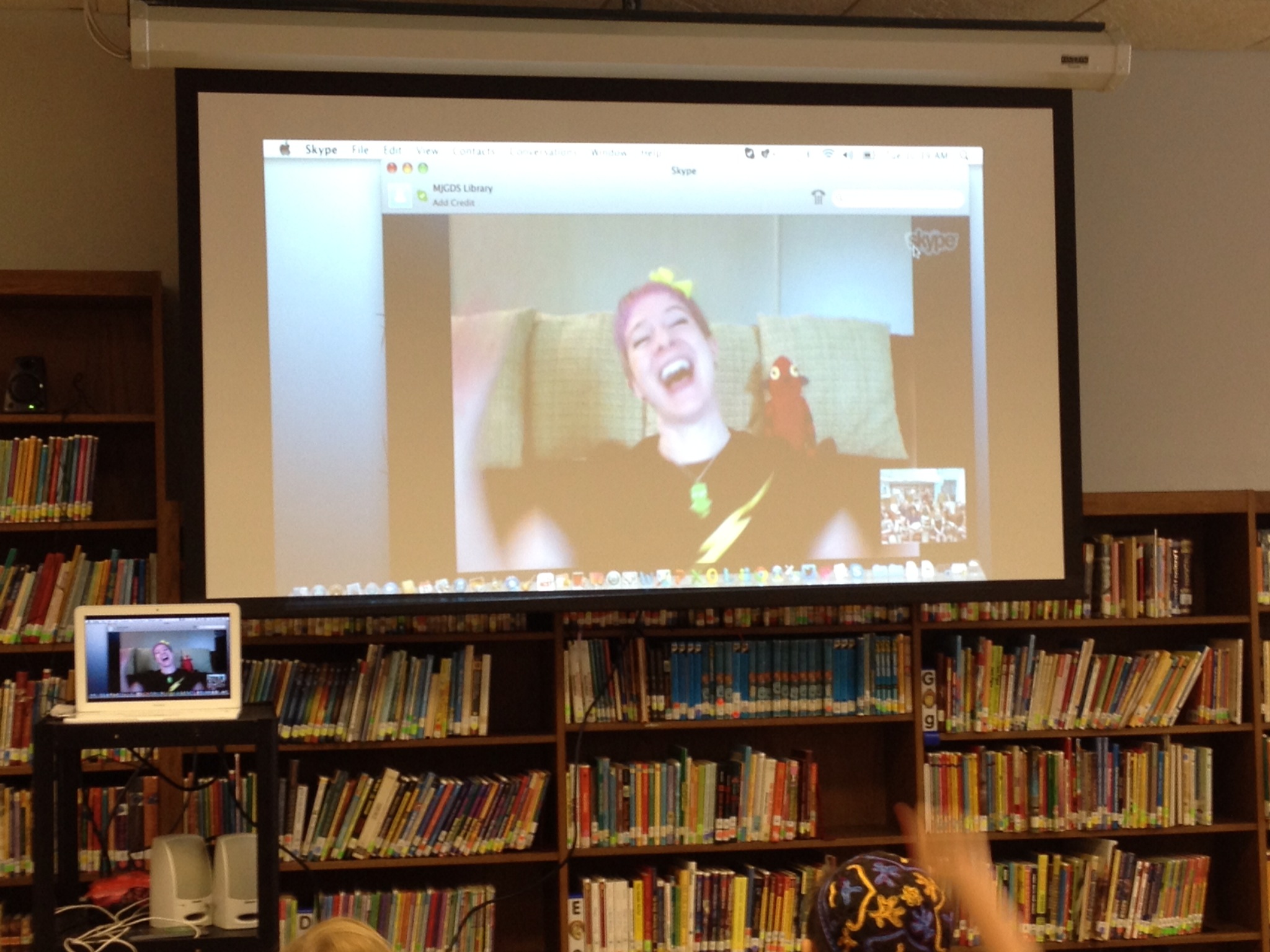
My first graders and I had our very first author Skype visit! Now we are hooked! We had the great pleasure to visit with children’s book author Ame Dyckman, who published her first book last year, Boy + Bot. A second book is scheduled to come out this year, and she is already working on her third publication. Boy + Bot is a simple story about friendship and differences. Many of the beautiful  illustrations are wordless, but brought to life by Dan Yaccarino’s art. Ame gave freely of her time, a generous 30 minutes, visiting with us in Florida from her living room in New Jersey.

photo 5

To prep the students for our visit, I showed them the book trailer and then read the story. The students quickly articulated the theme: Friendship and being different. Several students listed how their friends are different from them, but are still great friends.

Then we brainstormed possible questions to ask Ame. Our curious students generated a long list, ranging from “What was your inspiration?” to “How long did it take you to write the book?” to “How do you publish a book?” to “Where do you live?” to “How many pets do you have?” and “What is your favorite sport?” Each student then chose a question and wrote it on a piece of paper. To avoid duplication, we went around the room and replaced those questions that were repetitive.

photo 1 13-22-23

During the Skype visit, two of our students introduced the class and then each student asked their question. Ame was so engaging and entertaining, generating more and more questions and comments! If we hadn’t kept her for 30 minutes already, our students would have gladly visited with her some more.

One student asked Ame to read a story and much to everyone’s delight, she read Bark, George by Jules Feiffer, one of her favorites. To top it all off, Ame had sent a package with Boy + Bot bookmarks, stickers, and bracelets — enough for each student in the class and extra for the library.

photo

My take-away: Skyping with Ame Dyckman was a perfect introduction to virtual visits with authors. Students were engaged and inspired. This was an authentic event, telling students that authors are indeed real people who work hard at their craft to produce beautiful stories.

photo 2

Thank you, Ame!

Acrostic Poetry and PicCollage

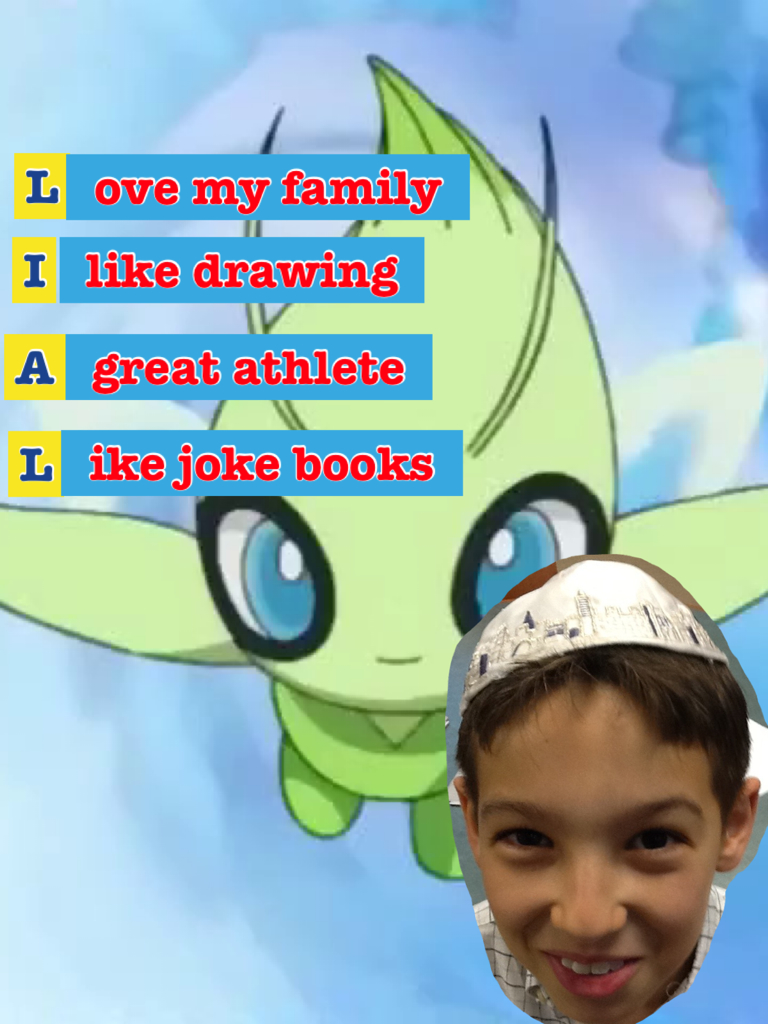
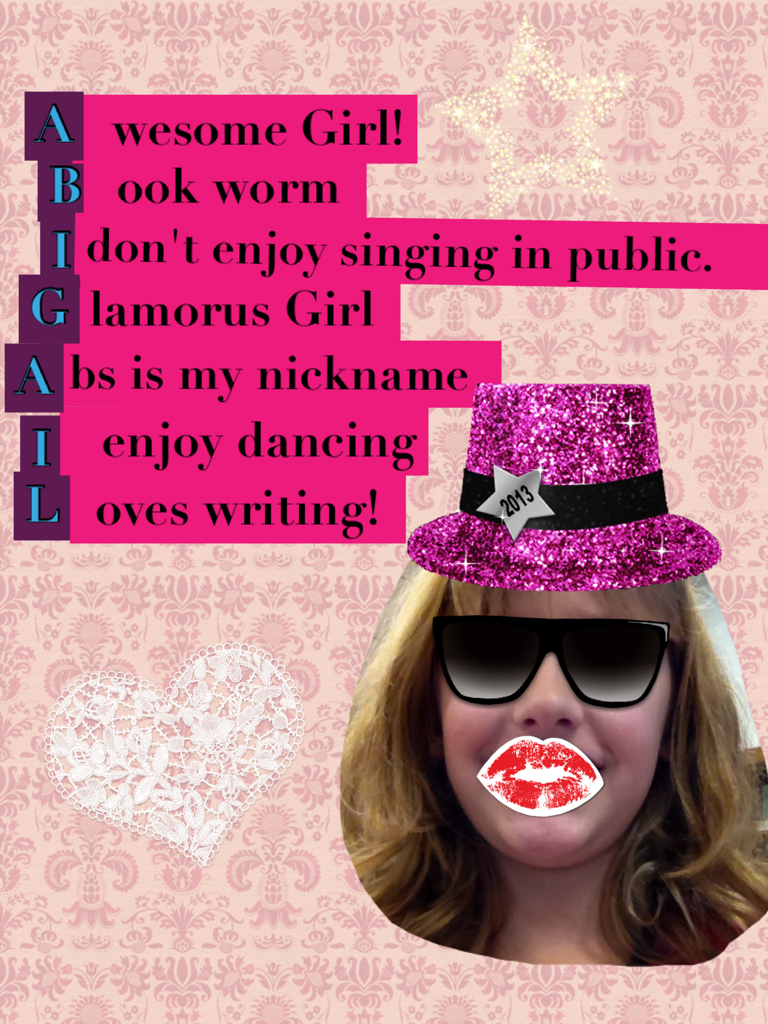
In 3rd grade, we continued our celebration of National Poetry Month. Students wrote acrostic poems and created an artifact for their blogfolios. An acrostic poem uses the letters of a word or name to begin each line of the poem, and each line must in turn relate to the word — a fun and very simple form of poetry. The subject can be anything. For our mini-lesson, students used their first names for their topics.

We began by looking at an example of an acrostic poem. Then, using pencil and paper, students brainstormed a list of words or phrases that describe them best and used those words/phrases to let their creative juices flow and draft their poems.

photo 2-1

Once poems were written, students used the PicCollage app for iPad to create their artifacts. I modeled the process and then it was the students’ turn.

In PicCollage, they took photos of themselves (or had a friend do it for them). They “clipped” their images and then added their poems. To make the first letter of each line stand out, the instructions were to choose a background color different from the rest of the text.

photo 3-3

This was a fun and quick lesson, forcing students to think of attributes that describe themselves and apply them in a creative way.

AllieB

LialA

JuliaD

AbigailF

Visualizing Shel Silverstein

It’s National Poetry Month–and since I love Shel Silverstein’s work (and we have a good number of his books in the library), I did a mini poetry session with 3rd grade in the library last week. As an introduction, we watched “Ickle me, Pickle me, Tickle me too” (see ShelSilversteinBook’s channel on You Tube) read by Silverstein himself. My goal for this lesson, however, was for students to understand “visualization” as a comprehension strategy: Make a mental picture to help you understand text.

I adapted a great lesson about visualization from a math (yes!) site and read-aloud the following poem:

Shapes

A square was sitting quietly

Outside his rectangular shack

When a triangle came down–keerplunk!–

And struck him in the back.

“I must go to the hospital,”

Cried the wounded square,

So a passing rolling circle

Picked him up and took him there.

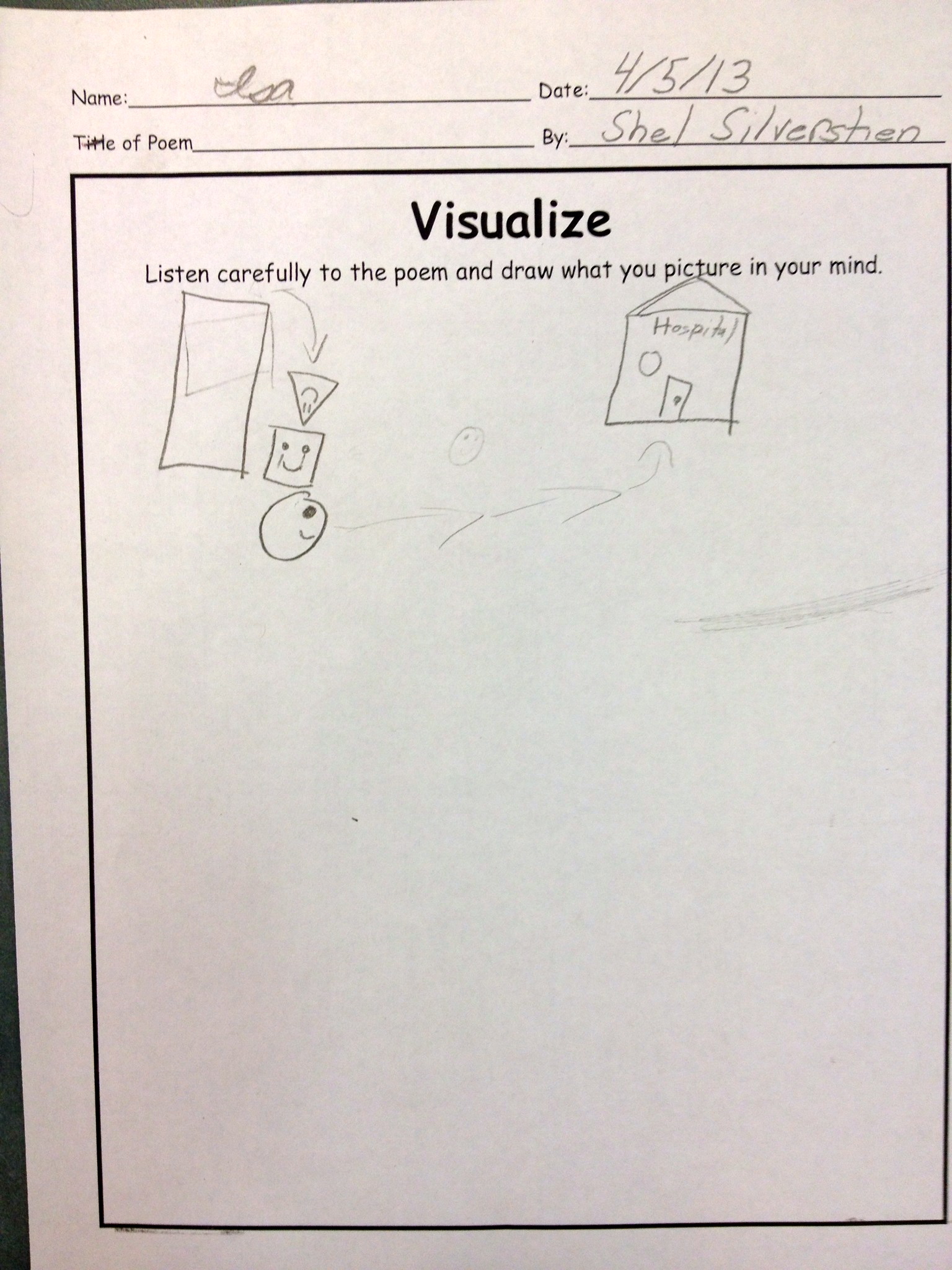
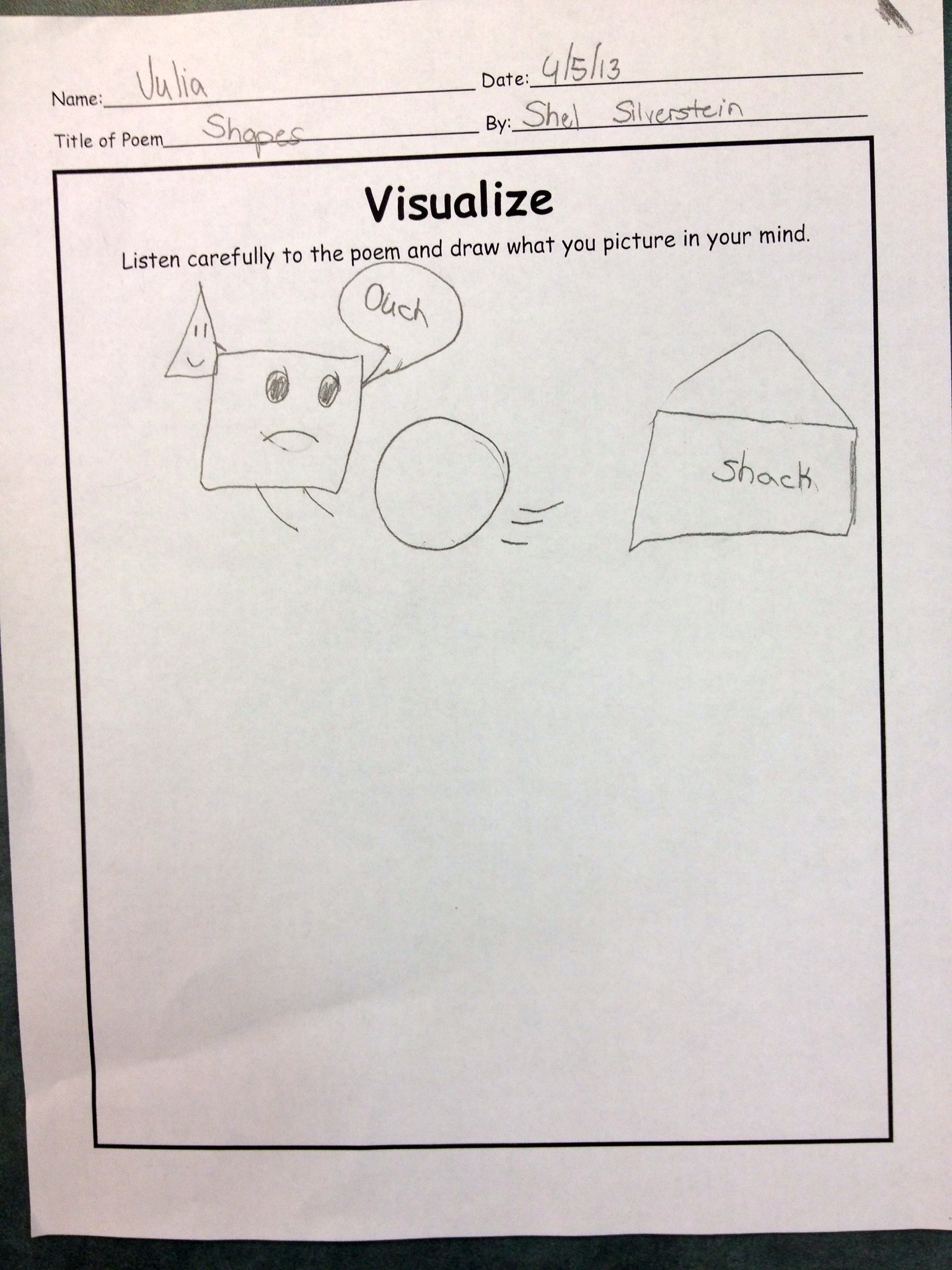
As I read the poem, students were drawing their visual interpretations of the poem. It was interesting that a couple of students were worried about what or how to draw. I had to emphasize and re-emphasize that there is no right or wrong way and that we all form different mental images of text. The result was a very unique illustration from each student. Some focused on the shapes, some on the hospital.

photo 1

photo 2

photo 3

photo 4

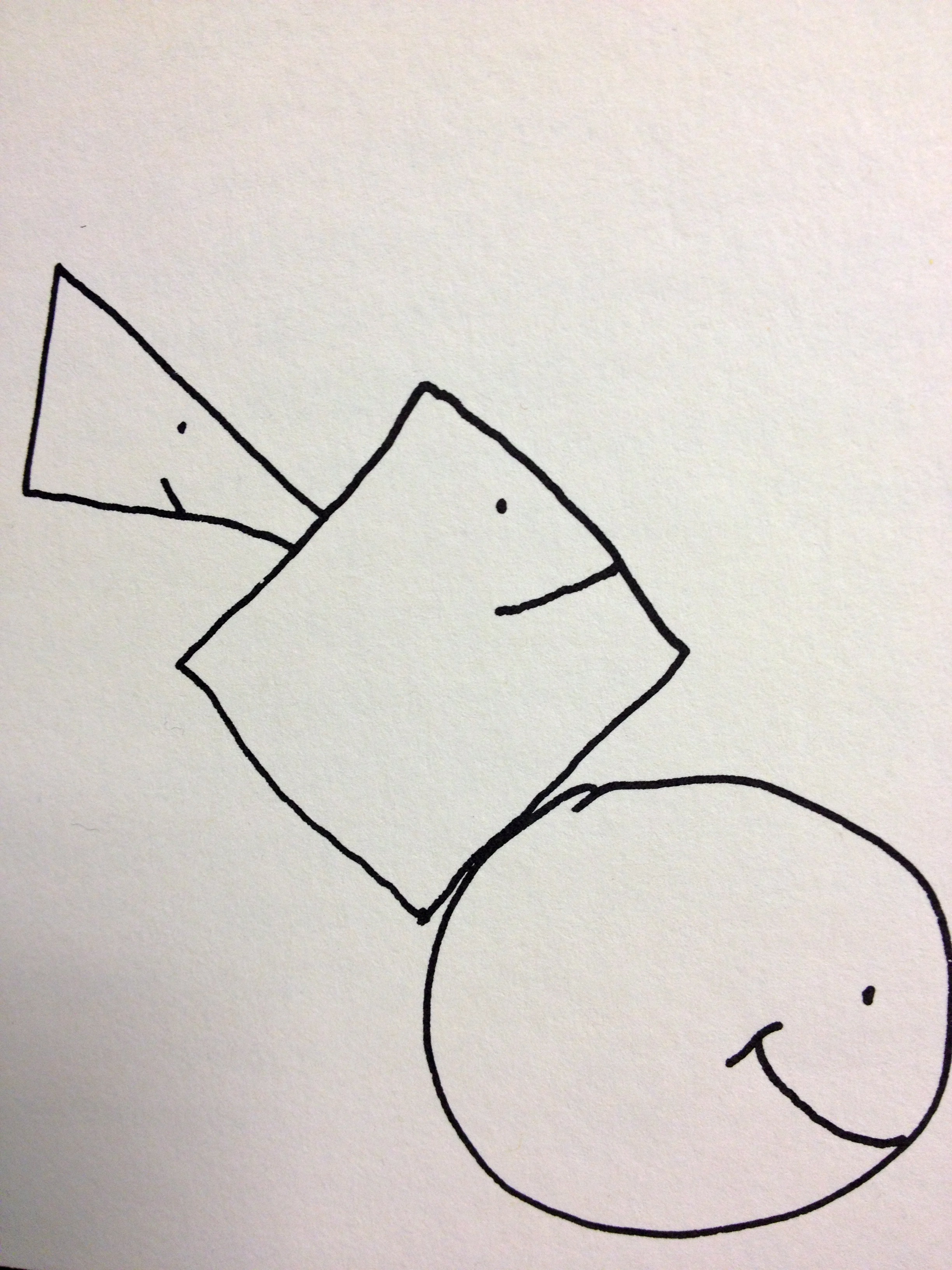
Then I shared Silverstein’s illustration with the class. As it turns out, he chose to not illustrate one part of the poem. Can you guess what is missing in Silverstein’s illustration?

photo

(From A Light in the Attic, 1981)